Press "Enter" to skip to content

IFAcontemporary

Reorienting Sari Dienes: A Conversation with Alexis Lowry Murray and Delia Solomons

On December 16, 2014, Marci Kwon sat down with Alexis Lowry Murray and Delia Solomons, who co-curated the exhibition Sari Dienes at the Drawing Center. All are PhD candidates at the IFA.

Sari Dienes, NYC, ca. 1953-1955. Ink on webril, 36 x 72 in. Private collection of Pamela Jarvis, NY. Image courtesy Sari Dienes Foundation. Licensed by Vaga, New York, NY.

MK: To begin, how did you come up with the idea for the show? And what was it like putting it together?

ALM: It was surprisingly simple. While researching Jasper Johns, I came across Sari as a side note in the catalogue for the Jasper Johns retrospective, organized by Kirk Varnedoe. Delia and I had been talking about curating a show together, and think I waited only twenty minutes before I talked to her about it. We looked up the Sari Dienes Foundation website, and were immediately interested in the rubbings she made, and the indexicality of that process. We made an appointment to go to the Foundation – we simply called their phone number – and when we got there it was instantly clear to both of us that an exhibition was the best idea. We had gone up to the Foundation open-endedly–for a moment I even thought about doing a dissertation on Sari–but we immediately knew an exhibition was best.

DS: The works looked incredible in person–really delicate and yet with this substantial scale. While examining them in the barn, we instantly pictured them on white walls in a gallery or museum space in New York, back in the urban context where she originally made these works.

MK: You first saw them in a barn?

ALM: Sari’s work is housed in a barn that is cared for by her Foundation. Barbara, the curator of the Foundation, and her husband Rip live in upstate New York where Sari used to live. Sari used to work in the Foundation’s barn, and it is literally chock-full of art.
The Veil of Cy Twombly

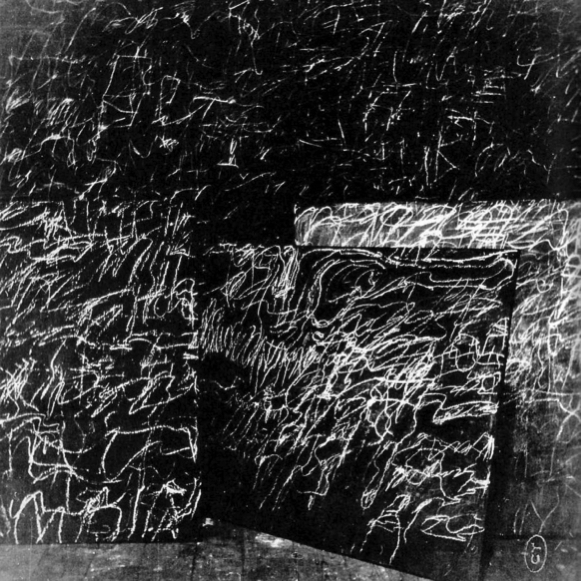
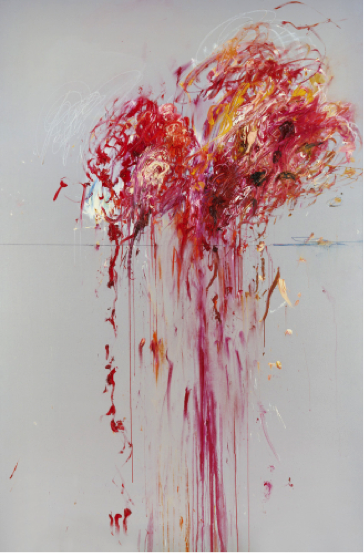
Cy Twombly was living in Rome when he painted Treatise on the Veil (Second Version), a massive canvas now on view at The Morgan Library & Museum (through January 25, 2015). It was 1970, four years after he’d delved headfirst into a world ruled seemingly absolutely by gray and white. Twombly’s shift in style could be seen as a return to the “blackboard” aesthetic he’d first pioneered in the mid-1950s with three thickly impastoed, staccatoed canvases, only one of which (Panorama, 1955, Daros Collection, Zurich) survives today. But the artist’s gray-ground period, a five-year stint between 1966 and 1971, illustrates an abandonment of the caustic scratches of his earlier work in favor of a line that is less fragmented and more fluid, less automatic and more calculated, less shrill and more lyrical. Indeed, Treatise was inspired by Pierre Henry’s avant-garde musical composition, The Veil of Orpheus, which records the tearing of a piece of cloth. In his translation of aural to visual phenomena, Twombly reduces his subject matter to its simplest parts, distilling and crystallizing its formal components so as to strengthen its visceral effects.

Cy Twombly’s canvases (including Panorama at back) in Robert Rauschenberg’s Fulton Street studio, ca. 1954.  Image courtesy Le temps retrouvé, Cy Twombly photographe & artistes associés, Collection Lambert (Avignon, été-automne 2011) via The Plumebook Café.
Photograph showing Cy Twombly’s canvases (including Panorama at back) in Robert Rauschenberg’s Fulton Street studio, ca. 1954. Image courtesy Le temps retrouvé, Cy Twombly photographe & artistes associés, Collection Lambert (Avignon, été-automne 2011) via The Plumebook Café.

The Morgan’s installation beautifully captures the visual harmony of Twombly’s work. In all its epic grandeur (the canvas stretches more than thirty feet), Treatise sits in the center of a single gallery, a crescendo amidst a twelve-drawing accompaniment. The drawings radiate centrifugally onto the surrounding walls, at once bracketing and barricading their attendant canvas. About twenty-seven by thirty-six inches each, the drawings are supplementary but not preparatory, and they are positioned as such: separate but equal. As the introductory text asserts, rightly, Treatise is “a meditation on time and space.”[1] The curators have done well to bolster these temporal underpinnings by orchestrating the drawings in approximate chronological order. But the sheer scale of Treatise, hubristic in its spatial demands, along with its diaphanous layers of media suggests something deeper stirs beneath the painting’s surface.

Cy Twombly, Nine Discourses on Commodus: Part VIII, 1963. Oil, wax crayon, and pencil on canvas, 204 x 134 cm. Image courtesy Guggenheim Bilbao Museoa.

Biomorphic, Electric, Robotic: Nam June Paik at Asia Society

“The real issue is not to make another scientific toy, but how to humanize the technology and the electric medium.” – Nam June Paik, 1964

The staircase at the Asia Society Museum leads to an enlarged, transparent image of Nam June Paik sitting between two illuminated globes, contemplatively with chin in hand, wearing miniature televisions inset in a pair of eyeglasses. The image exemplifies the artist’s prescient thinking and his futuristic worldview wherein today’s technological advancements could exist. It is a fitting introduction to Nam June Paik: Becoming Robot (through January 4, 2015), the first solo exhibition of the artist’s work in New York in over a decade. The exhibition, designed by Clayton Vogel and curated by Michelle Yun, is an effort to broaden the understanding of Paik’s practice beyond his legacy as the originator of video art in the 1960s, and to situate his use of technology as a medium within the wider framework of late twentieth- and early twenty-first-century art.

Paik, born in Seoul in 1932, studied music and aesthetics at Tokyo University and went on to continue his musical studies in Germany, where he met visiting composer John Cage, who largely inspired Paik’s experimentation in avant-garde music and art. Moving to New York in 1964, Paik began working mainly on music-based live performances until his experimentation with televisions catalyzed the shift in his practice to object-based work.

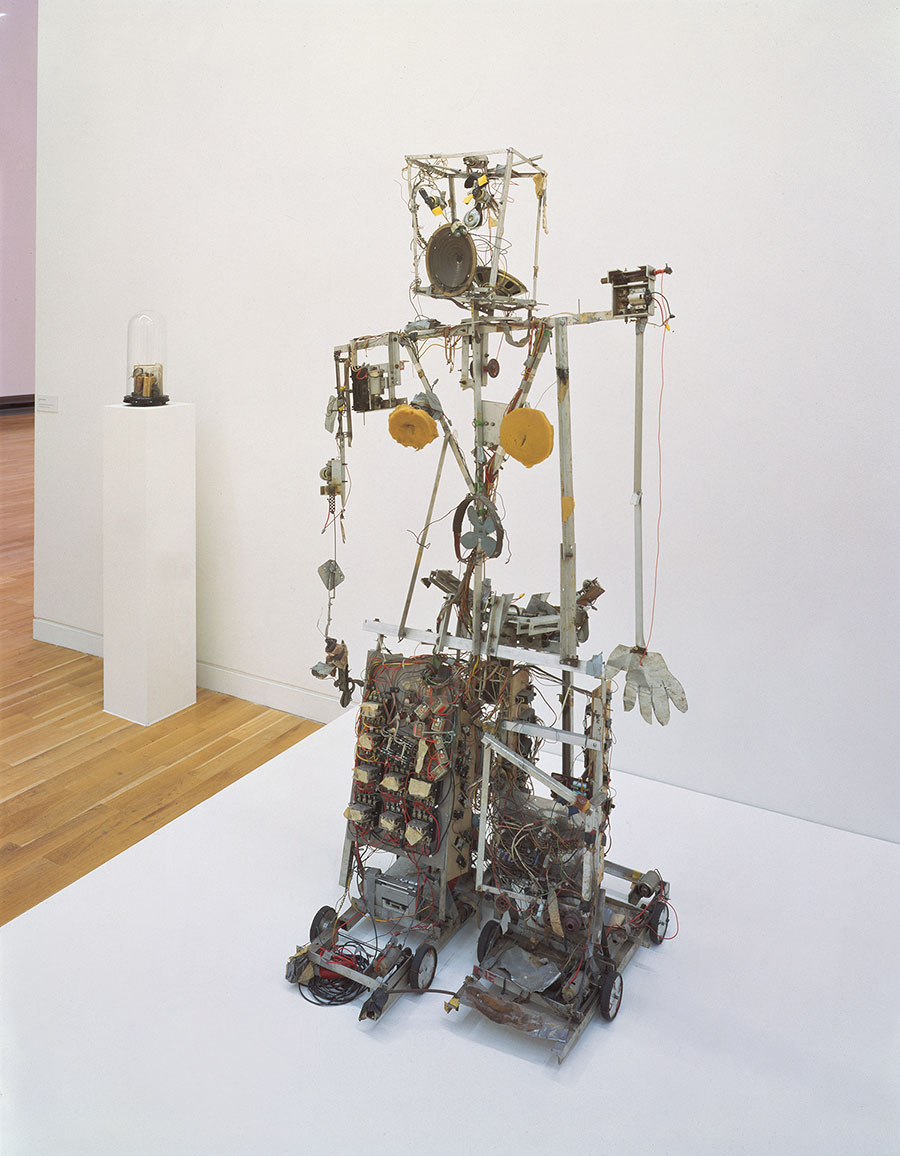
Robot K-456, 1964. Twenty-channel radio-controlled robot, aluminum profiles, wire, wood, electrical divide, foam material, and control-turn out. 72 x 40 x 28 in. (183 x 103 x 72 cm). Friedrich Christian Flick Collection im Hamburger Bahnof, PAIKN1792.01. Photo: Roman März, Berlin.

The exhibition at the Asia Society spans the entirety of the museum’s two floors. Moving thematically through Paik’s oeuvre, the show begins with a section dedicated to Robot K-456, a twenty-channel radio-controlled robot created in 1964 and crafted with aluminum, wire, wood, electrical divide, foam material, and control-turn out. Based in human proportions, the biomorphic assemblage was programmed to walk and talk and was the subject of numerous performance-based projects. Presented on a simple screen set into the gallery wall (which successfully differentiates it from Paik’s own TV-based works) is a news account of First Accident of the Twenty-First Century, which was performed in 1982 on the occasion of the artist’s major exhibition at the Whitney Museum. The choreographed piece subjects the robot to a car accident while crossing Madison Avenue at 75th Street. As the robot falls to the ground in the footage, the beholder hears distressed shouts, proving that Paik has created a subject biomorphically familiar enough as to incite empathetic reactions. At a time when technology was advancing into a more pervasive component of daily life, humanizing the medium was Paik’s attempt at making it more approachable. The work’s reception in television media muddied the line between art and popular culture, and the piece itself reiterates Paik’s intention of manifesting the human condition through the mediums of science and technology.

An Exchange of Trust: Marina Abramović at Sean Kelly Gallery

Marina Abramović is back in New York City, but this time, she won’t be seen. On her last visit, Abramović performed The Artist is Present (2010) for the blockbuster MoMA retrospective of the same name. For 736 hours and 30 minutes, Abramović sat immobile in MoMA’s atrium faced, one by one, by silent visitors. Most recently, she spent 512 hours at the Serpentine Gallery, guiding visitors through an empty space and occasionally presenting them with an everyday object.

The author cautiously moving through the space. Image courtesy of Generator by Marina Abramović.

Now, at Sean Kelly Gallery, Abramović’s Generator—a participatory work that focuses on “nothingness” and sensory deprivation—is on view (through December 6, 2014). Facilitators place blindfolds and noise-cancelling headphones on participants before leading them into the main gallery. Once inside, participants can move however they want (though told it is a “slow-moving” piece), touch whatever they want, and stay as long as they want. When ready to leave, the blindfolded raise their hands and a facilitator guides them out. Every movement is documented and presented on Tumblr; this aspect of the piece, however, only becomes apprehensible once outside the space, in front of a computer screen. During the exhibition’s run, Abramović will partake, too—unannounced and daily—but, of course, participants will not be aware of her presence.

Unfurling Sari Dienes

The exhibition of Sari Dienes’s work at The Drawing Center (on view October 8 to November 16, 2014) highlighted the artist’s innovative and experimental approaches to mark making in her large-scale rubbings of New York City streets from the 1950s. On November 13, the curators of the exhibition (and current PhD candidates at the IFA), Alexis Lowry Murray and Delia Solomons, led a public tour that introduced Dienes’s work by examining the dynamic interplays of processes and textures in her drawings. During the tour, Solomons and Lowry Murray gave context to Dienes’s practice by underscoring her creative exchanges with contemporaries such as Jasper Johns and John Cage. Following the tour, artists Alison Knowles and Gillian Jagger talked with NYU’s Julia Robinson about their mutual interests in using found forms and textures from natural and urban landscapes in their work.

Peter Moore, photograph of Sari Dienes demonstrating the street rubbing process, 1970. Gelatin silver print, 6.5 x 9.75 in.

Sari Dienes (1898—1992) was born in Hungary and was a student of Purists Fernand Léger and Amédée Ozenfant. By 1936, she was Assistant Director of Ozenfant Academy of Fine Arts in London. She moved to New York City in 1939 where she soon befriended artists both established (Mark Rothko) and emerging (Johns and Cage, as well as Ray Johnson, Robert Rauschenberg, and others), many of whose names are listed in pages from the guest book from her studio. On Thursday night, Lowry Murray and Solomons emphasized Dienes’s willingness to experiment with found materials and new processes, and her subversive recoding of established notions of the authorial gesture, qualities that are as important today as they were to Dienes and her contemporaries as seen, for example, in the work of Ray Johnson, Rachel Whiteread, and Rirkrit Tiravanija.

Finding Balance at Paris Photo 2014

This past weekend, photography fans and connoisseurs descended upon the Grand Palais for the 18th annual Paris Photo Fair. Held November 13-16, 2014, it boasted 143 galleries and twenty-six art booksellers representing thirty-five countries. Grandiose and historically rich, the venue provided ideal conditions for viewing photographs: the sprawling dome of the Grand Palais offered abundant natural light, while the tightly-packed booths were simple, cut-to-the-chase affairs, with off-white walls.

The upper level of the Grand Palais functioned as a non-commercial gallery space for recent acquisitions from the Museum of Modern Art as well as for the Alkazi Foundation for the Arts’ collection of early Indian and South Asian photography. Smaller wings displayed works sponsored by Giorgio Armani, JP Morgan Chase, and BMW. These spaces, located at the top of a grand staircase and away from the bustling ground floor, subtly linked the works on sale at Paris Photo with private, museum-quality collections, and underscored the potential for these photographs to act as investment pieces.

The beating heart of the fair was a social space at the base of the grand staircase, which was continually abuzz with visitors flipping through art tomes and awaiting artists’ signatures. Ample opportunity to encounter the artists themselves contributed to the sense that Paris Photo not only stimulates monetary transactions, but also the transaction of knowledge between enthusiasts and a shared passion for the medium.

Augmented Reality Enters the Conservation Laboratory

On October 22, 2014 at the Institute of Fine Arts, Jens Stenger gave a talk titled “Non-Invasive Color Restoration of Mark Rothko’s Harvard Murals Using Light from a Digital Projector” on behalf of his team (Santiago Cuellar, Rudolph Gschwind, Ankit Mohan, Yasuhiro Mukaigawa, Ramesh Raskar, Katherine Eremin and Narayan Khandekar).

Stenger presents the team's target image, the compensation image, a painting's present faded state, and its appearance with the projection in the IFA Lecture Hall. Photograph by the author.
Stenger presents the team’s target image, the compensation image, a painting’s present faded state, and its appearance with the projection in the IFA Lecture Hall. Photograph by the author.

Like many conservation chronicles, this riveting lecture on the recent restoration of Mark Rothko’s storied Harvard Murals had all the elements of a blockbuster drama. The story’s stakes ride not only on the status of the artist—an immeasurable giant of post-war modernism—but also on the works’ conservation history. The five paintings on canvas that comprise the murals were completed in 1962, making these Rothko’s first site-specific grouping of paintings (they were followed by his canvases for Houston’s 1967 Rothko Chapel). The Harvard Murals, as they are known, were made for the boardroom of the university’s new Holyoke Center, designed by Josep Lluís Sert, then Dean of the Graduate School of Design.

The Holyoke Center’s conference room boasted excellent natural light, and over the years the paintings—originally grounded in a deep, winelike crimson of Rothko’s own making, with a different intense hue in each canvas’s foreground—faded abysmally. In the 1980s, a team of conservators determined that the main culprit in the fading was Lithol Red, a highly fugitive pigment that provided the backbone of the murals’ striking crimson. Following this discovery, the paintings were put on public display for the first time in 1988—to general outcry. The paintings that had languished in seclusion during Rothko’s canonization now struck art historians, critics, and the artist’s heirs as withered corpses, shadows of their original glory. After this debacle, the paintings were kept in storage, rarely to be seen again. Until, that is, Stenger’s team proposed a radical new solution.

EXPAND//FOLD//COLLAPSE// Sculptures by Marta Chilindron: A Conversation with Great Hall Exhibition Curators, Susanna Temkin and Katharine Wright

The following is a transcript of a conversation between IFA PhD candidates Susanna Temkin and Katharine Wright and Master’s student, Caroline Barnett. Temkin and Wright are the co-curators of the Great Hall Exhibition program for the 2014-2015 academic year. The interview took place on October 27, 2014.

Marta Chilindron, Cube 48 Orange, 2014, acrylic, dimensions variable: closed: 48 x 48 x 48 in., Courtesy Cecilia de Torres, Ltd.

CB: So, tell us a little bit about the show. What can we expect to see?

ST: We’re going to be installing a total of eight works by the artist Marta Chilindron, three of which are large-scale. Chilindron creates manipulable sculptural works using transparent and multi-colored plastic-based material. For the show, we are installing works throughout the Great Hall. We wanted to make as much use of the space as possible, so they will be in the vestibule, the lobby space, and on the marble table on the platform right below the staircase. But, right now things are tentative. We’re giving this interview before we do the installation, so we will have to see how everything plays out.

CB: It’s appropriate that the installation is in flux – expanding and collapsing like the title.

ST and KW: Yes!

CB: What were the challenges of curating a show in the Duke House? I imagine it has a lot of limitations.

KW: One of the challenges is the nature of the space…there are a lot of things you have to work around. It’s a place of major circulation; everyone who comes in and out of the building has to go through there at some point – there are classrooms, offices, our lunch room. So that really hinders where you can exhibit things.

ST: This is not a traditional exhibition space. It’s challenging: we had no walls, we had to really respect the building, people have to be able to use it, it’s not climate controlled, etc., etc.

KW: But that’s why Chilindron’s work is so exciting because it dictates that kind of movement and manipulation of space; it can fill it or contract as need be. For example, right now we are involved in discussions about the work, Green Pyramid (2006). Depending on how we choose to install the piece, it can stretch from a hexagonal shape with a diameter of eight feet to a much more condensed, triangular form that uses about half of the floor space.

CB: You can’t change the lighting, can you?

ST: Yes! The building staff will help with spotlights. However, one thing that is important about Chilindron’s art is how the nature of the materials she works with – transparent acrylics and other plastics-based media – interacts with the light effects of the space. I’m really excited to see how the works we install near the staircase will reflect light filtering in from the Duke House’s skylight. For students, I think it will be nice to see how the works change throughout the course of the day or with the weather, for example.

CB: Are you two continuing the program into the spring?

KW: We’ve been tasked with organizing the spring exhibition. I should explain that we’re co-organizers and co-curators of this year’s Great Hall Exhibitions, but Susanna has taken the lead on this show in the fall, and I’m going to take the lead in the spring. We’re still in the process of negotiating what the next exhibition will entail.

Challenging Gridlock for Gridwork: A Trip to Harlem for Early Charles Gaines

The current exhibition at the Studio Museum in Harlem, Charles Gaines: Gridwork 1974-1989 (on view through October 26, 2014), encompasses an era of the artist’s work before he began confronting social content and identity head-on, as in the 1993 exhibition and publication, The Theater of Refusal: Black Art and Mainstream Criticism, which examined racial determinism in the artworld at that time. Despite the fact that the exhibition catalog and wall texts at the Studio Museum explain Charles Gaines as an artist who explores the “relationship between aesthetics, politics, language and systems,” the political and racial implications seem absent in this period of his oeuvre, or at least buried deep within systematical and conceptual thinking.

Charles Gaines Motion: Trisha Brown Dance, Set #1, 1980–81 Collection of James Keith Brown and Eric Diefenbach Courtesy Susanne Vielmetter Los Angeles Projects Photo by Robert Wedemeyer.
Charles Gaines, Motion: Trisha Brown Dance, Set #1, 1980–81. Collection of James Keith Brown and Eric Diefenbach. Courtesy Susanne Vielmetter Los Angeles Projects. Photo by Robert Wedemeyer. Image courtesy the Studio Museum.

One familiar with the aim of the Studio Museum – as well as Gaines’s more contemporary works – might anticipate a different body of work, one that confronts more evidently the “influence or inspiration from black culture,” as per the Museum’s mission statement. Rather, methodology and conceptualism – an influence likely stemming from Sol LeWitt, a major influence in Gaines’s career – come to the fore. The walls of the first room of the exhibition are lined with artworks featuring massive grids, among which are the key series Regression (1973-74), Color Regression (1978), and Numbers and Trees (1986-89). The impressive scale of a majority of the work is tempered by the delicate, precise handwriting that embellishes their grids and margins. But the monumentality of Gaines’s work has less to do with its physical size than the painstaking process that produced it. As the shapes and colors in the Regression drawings vary, it becomes apparent that each is driven by arithmetical operations, building upon each other and constructing systems similar to self-referential fractals.

Notes from the Street: Charles Simonds at the IFA

On October 7, for this year’s inaugural Artists at the Institute lecture, Charles Simonds delivered an energetic and astute summation of his career to date. He began with his earliest Dwellings—miniature architectural structures, made of clay, sand, and small bits of wood—which in the early 1970s seemed to emerge organically from the gutters, broken walls, and empty lots of downtown New York, springing up wherever the city’s crumbling infrastructure afforded a place for their putative inhabitants, whom Simonds dubbed the “Little People.” Simonds’s rich practice, which incorporates elements of sculpture, architecture, urban planning, craft, performance, conceptualism, narrative fiction, and social engagement, has taken many forms in many places since those early breakthroughs. Yet even today, viewers seem perpetually drawn back to the original Dwellings, which remain landmarks of his artistic practice and of the downtown scene though they exist only in photographs and in memory.

Dwelling, East 6nd Street, New York, 1974, clay, sand and wood. Photo courtesy www.charles-simonds.com.
Dwelling, East 6nd Street, New York, 1974, clay, sand and wood. Photo courtesy www.charles-simonds.com.

There are many reasons for this consistent focus on Simonds’s early work, not least the powerful charm exerted on us by things that are gone. The Dwellings’ loss helps establish them as a kind of founding myth—both for Simonds’s mature work and for the narratives he wove within it. But at play here is also the art world’s typical exhaustion with itself, the self-disgust that has, since Duchamp, drawn art irresistibly toward things it hasn’t yet absorbed. For that reason viewers may think that the Dwellings’ natural habitat is the city, and the white walls of the museum can showcase only taxidermied specimens, removed from both context and life.