Press "Enter" to skip to content

IFAcontemporary

Painting the Infinite: Roman Opalka at Dominique Lévy

The show at Dominique Lévy is Roman Opalka’s first U.S. exhibition after the artist’s sudden death in 2011. Divided between two floors of the gallery’s Upper East Side brownstone building, Roman Opalka: Painting ∞ provides a synopsis of the artist’s career by showcasing over twenty five works in different media. Although Opalka’s art may at first appear modest, this show proves its uniqueness and complexity. By focusing on the artist’s inimitable technique, Roman Opalka: Painting ∞ offers insight into his scrupulous and orderly approach to Conceptual art.

Second Floor Installation View of Roman Opalka: Painting ∞ at Dominique Lévy. Courtesy of Dominique Lévy. Photo credit: Guillaume Ziccarelli.

Opalka, who was born in France but raised and educated in Poland, began his artistic career in Warsaw during the late 1950s by experimenting with the “phenomenon of disappearance.”[1] The gallery’s third floor, devoted entirely to Opalka’s earlier works, presents the effects of these experiments with two of his 1963 black-and-white Chronome paintings and the series Étude sur le Mouvement (1959-1960), made with black ink on paper. As one walks around the room, the artworks reveal themselves as precursors to Opalka’s later work in their conscientious method of execution and monochromatic aesthetic. The smudges of ink in Étude sur le mouvement, though visibly influenced by gestural works of the American Abstract Expressionists and their European counterparts, the Tachists, reveal his fascination with repetitive patterns. Across the room, two tempera paintings from 1963, Chronome II and Chronome IV, present an intertwining of black and white spots, creating a nearly monochromatic surface.

Chromes at Home at Room & Board

An oft-forgotten fact about Ad Reinhardt, the American artist best known for his black monochrome paintings, is that he was an avid photographer who made a practice of presenting his pictures in slideshow format. Throughout the 1950s and ‘60s, he showed hundreds of slides from his travels to his colleagues and to Hunter College students in rapid-fire succession. Reinhardt grouped images by formal and compositional qualities irrespective of geography or culture, hoping to overpower viewers’ capacity for identification and to induce a new way of looking. Long attention spans, Reinhardt thought, were in increasingly short supply. In the face of a mounting onslaught of modern distractions, only time and patience would reward the diligent observer.

Details from the series “Northwestern Chromes” (2014).
Detail from the series “Northwestern Chromes” (2014), image courtesy Samuel Budin.

In terms of photographic technology, a lot has happened since Reinhardt’s presentations, but his ideas about an image’s ability to condition and edify its audience are not out of date. Last Saturday evening, a living room slideshow also sought to provide a counterpoint to the normal circumstances of contemporary art production and consumption. It was a festive conclusion to photographer Samuel Budin’s month-long stay at Room & Board, an “experimental residency” run by IFA doctoral student Julia Pelta Feldman. For a month, Budin lived at Feldman’s home in Williamsburg; while saving a month’s rent (no laughing matter in New York), Budin worked closely with Feldman to finalize the exhibition Northwestern Chromes and Other Chromes, a two-part documentation of his travels in the Pacific Northwest.

Blowing Up                                                   The Koons Effect

The Koons Effect, A Symposium at the Institute of Fine Arts, September 12, 2014. Photograph by Jason Varone.

Adding to the ever-increasing influx of (add preferred noun here: airtime, hype, prestige, simple volume of written or spoken words) about Koons’s work in the wake of the Whitney’s current retrospective, the joint IFA-Whitney symposium, The Koons Effect was a game participant. Unlike much of the other dialogue around the show, however, The Koons Effect aimed for tough methodological questions from the start; indeed the symposium could be said to have centered on the question of whether Koons’s work proves itself beyond the pale of established historical interpretative frameworks and vocabularies, warranting something “new.” Two points were immediately clear: facile and default recourse to models (like the commodity fetish) or to figures (like Duchamp and Warhol) bear little fruit in the collective effort to advance the discourse on Koons, and the lighter the reliance on the artist’s own manicured explanations and language of self-presentation, the deeper the insight.

Rather than synopsizing the conference here, however, what follows are abbreviated summaries of four of Friday’s eight presentations, in part to signal their diversity (I consider only part two of the event, the September 12 proceedings, which were fully recorded and are available online). The challenge of precisely summarizing any individual talk points not only to the complexity of the ideas grappled with and the lines of inquiry opened up, but—and maybe more importantly—the supremely unresolved state of current thinking on the artist. Whitney curator Scott Rothkopf’s show is revelatory for bringing the full trajectory of Koons’s production into view, enabling—unbelievably—for the first time what one hopes will be a spate of ambitious art historical work based on direct experience and study of the objects.

Modes of Defiance: Latin American Art, 1970 to the Present

For the inaugural meeting of this year’s Latin American Forum on September 9th, Professor Edward Sullivan moderated a panel discussion titled Modes of Defiance: Latin American Art, 1970 to the Present, which met in conjunction with the exhibition Bearing Witness: Art and Resistance in Cold War Latin America at John Jay College of Criminal Justice (now closed). The panelists included two IFA alumnae, Dr. Estrellita Brodsky, a chief curator of the exhibition, and Dr. Jason Dubs, the Museum Research Consortium Project Manager at The Museum of Modern Art, as well as Dr. Joaquin Barriendos, Assistant Professor at Columbia University, and Dr. Claudia Calirman, Assistant Professor at John Jay College.

Looking at artwork from Latin America during moments of violence and oppression – both historical and contemporary – the panelists spoke about the ways in which art can engage in various strategies of resistance. In discussing the scope of Bearing Witness, Dr. Brodsky laid out a few questions taken up by the exhibition that also served as touchstones for the following panelists. Probing the roles that historical images of violence play in today’s world (one already saturated with violent imagery), Dr. Brodsky asked if a work of art can help us understand our own complicity in the acts of injustice represented in the show and how it might compel us to respond. This raises important questions about what an artwork can accomplish through implicating the viewer. While not explicitly addressed in the panel, I found myself wondering: is the primary function of artwork that engages with powerful images of violence to spread awareness? Can, or should, the artwork do more? Perhaps most significantly, what is the responsibility of the viewer when encountering this kind of work? Questions about an artwork’s political agency emerged as the underlying framework for each of the panelists’ presentations.

Speaking on issues of witnessing and documentation, Dr. Barriendos discussed the ways in which archival material has been employed in exhibition settings as a way to provide witness accounts of violence. Calling for the creative reactivation of historical context within the space of the museum, Dr. Barriendos outlined several projects, such as Luis Camnitzer’s 1969 work Masacre de Puerto Montt (Massacre of Puerto Montt). Examples like this one offer alternative, often performative, methods of bearing witness in an endeavor to eliminate the perceived distance between the viewer and the artwork.

Lotty Rosenfeld, Una milla de cruces sobre el pavimento, Santiago, Chile, 1979.
Lotty Rosenfeld, Una milla de cruces sobre el pavimento, Santiago, Chile, 1979. Image courtesy Espaivisor.

Images of Struggle and Resilience: Ernest Cole at the Grey

All photographs date from the early 1960s through 1966.

In 1990, the South African court justice Albie Sachs famously penned an essay called “Preparing Ourselves For Freedom” in which he argued for a return to beauty in the arts, and an expansion of creativity beyond the decades of revolutionary cultural work aimed at supporting the anti-apartheid struggle. While the lifelong activist knew firsthand that political engagement had long been a matter of survival, he asserted that the repeated imagery of “fists, spears, and guns” might limit the creative imagination of the new South Africa, that “the range of themes is narrowed down so much that all that is funny or curious or genuinely tragic in the world is extruded. Ambiguity and contradiction are completely shut out.”[1]   Be that as it may, there will always be those rare, inspired cases in which the political and the beautiful need not be mutually exclusive, where complexity and ambivalence are found in the most seemingly black-and-white circumstances. The work of South African photojournalist Ernest Cole (1940-1990) offers one such example. His work betrays a deep commitment to both social and aesthetic engagement, which come together in a stunning portfolio of photographs that documents life under apartheid and pays homage to the persistence of humanity through struggle.

Ernest Cole: Photographer, organized by the Hasselblad Foundation and currently on view at NYU’s Grey Art Gallery through December 6th, is the first museum retrospective of Ernest Cole’s work, and one that is long overdue. The artist risked his life and ultimately sacrificed his citizenship in order to produce his seminal photobook House of Bondage, which remains one of the most visually powerful and politically incisive documents of the apartheid era.

Cole considered it his life’s work to chronicle the black experience from every angle: public and private, at work and at home, and inclusive of the perspectives of men, women, children, and families. He envisioned his target audiences to be foreigners – Europeans and Americans – both in the hopes of revealing the horrors of apartheid to the outside world, and in full knowing that he would never be able to distribute his work domestically (even today, the book is less known in South Africa than it is in the West, having only been published in New York and London in 1967). Across this presentation of over one hundred images, shot throughout the 1960s, we bear witness to not only the gross indignities inflicted on black South Africans by the apartheid system, but also a collection of more intimate, everyday moments that humanize and honor Cole’s subjects.

Ernest Cole, "Township mother fights losing battle to keep son, age nine, from running off to live life of the streets. She tries to assert authority with threats: 'What's your future going to be like without an education?' But it is too late; the boy - called Papa - is out of control." - House of Bondage, 1967. Silver gelatin print, 7 7/8 x 11 3/8 in. © The Ernest Cole Family Trust. Image courtesy the Hasselblad Foundation.
Ernest Cole, “Township mother fights losing battle to keep son, age nine, from running off to live life of the streets. She tries to assert authority with threats: ‘What’s your future going to be like without an education?’ But it is too late; the boy – called Papa – is out of control.” Caption from House of Bondage, 1967. Silver gelatin print, 7 7/8 x 11 3/8 in. © The Ernest Cole Family Trust. Image courtesy the Hasselblad Foundation.

Winogrand, Undeveloped

At the Metropolitan’s hosting of the SFMOMA retrospective exhibition Garry Winogrand (on view June 27 to September 21, 2014), the photographer’s quotations sprinkled through the galleries convey his annoyingly literal way of answering questions about his work. For example: Why did he photograph? To see “how the thing looks photographed.” Art historians might want a meatier explanation, but Winogrand stubbornly maintained his answers, with evasions that can sometimes seem facetious. About his complex and undeniably incisive photograph Los Angeles, 1969, he claimed, “It’s the light. Look at the light!”

Garry Winogrand, Los Angeles, 1969. © 1984 The Estate of Garry Winogrand. Photo courtesy The J. Paul Getty Museum, Los Angeles.

But wandering through the rooms of the exhibition eases any frustration with Winogrand. His photographs are masterful. They are slippery, unsettling, hilarious documents of the joys, pretensions, and tragedies of mid-century American life. While Winogrand is never quite cruel to his subjects, he is definitely unsparing. The loneliness of a new New Yorker, the sensuality of an uptown shopper, the strain of a tight swimsuit—even, in a winking move by the museum, the lasciviousness of a Met Centennial Ball attendee—all is documented.

In the Shadow of Utopia: Beyond the Supersquare at Bronx Museum of the Arts

It’s an old cliché, but one with staying power: try to visualize “Latin America,” and more often than not images of palm trees, sandy beaches, and dense rainforests come to mind. The tropical stereotypes are so persistent—and still so often invoked in exhibitions that attempt to survey art of the Americas—that it is fairly refreshing to encounter a show that deals with the natural world’s manufactured counterpart, namely the constructed urban landscapes that sought to define a new, modern identity for the region in the twentieth century. Taking the legacy of the modernist city as its theme, the Bronx Museum’s quietly devastating Beyond the Supersquare (on view May 1, 2014 to January 11, 2015) refuses to shy away from the thorny contradictions that lie at the heart of the built utopia in Latin America. Co-curators Holly Block and María Inés Rodriguez have presented the work of over thirty contemporary artists, mounting one of the most provocative and haunting shows of Latin American art in recent memory.

Photo 1
Beyond the Supersquare at The Bronx Museum of the Arts, Photo by Bill Kontzias. Image courtesy of The Bronx Museum of the Arts.

The titular “Supersquare” refers specifically to the supercuadra, a self-contained residential city block that served as the module for that most forward-looking of cities, Brasília. Famously carved out of the Amazon and inaugurated with much fanfare in 1960, Brasília is the apotheosis of the modernist dream and its inevitable failure: planner Lucio Costa’s vision for Brazil’s futuristic capital has been criticized as essentially inhuman, and just four years after its debut the city was overrun with tanks and military troops that ushered in a brutal dictatorship that would last over twenty years. The specter of Brasília looms large over the exhibition, and indeed it is summoned in a number of works included in the show. Mauro Restiffe’s photographic series Empossamento (2003) captures the inaugural festivities of popular president Lula da Silva, juxtaposing the fervor of exultant crowds with a shot of the vast, almost funereal emptiness of the following day. Alberto Baraya indicts Brasília’s superhuman scale in his Estudos comparados modernistas (2011), in which he photographed Oscar Niemeyer’s iconic government buildings along with his own hand holding a flower, possibly a symbol of the natural landscape supplanted by Costa’s vision—except the flowers are plastic, as lifeless as the concrete edifices.

Performance Art Takes Center Stage at Art Basel 2014 with “14 Rooms”

Photos by author unless otherwise indicated.

In addition to the staggering 233 modern and contemporary galleries at this year’s Art Basel (June 18-21, 2014 in Basel, Switzerland), notable were the separate spaces devoted to screening films by and about artists, performance art, and works that elude the (physical or conceptual) parameters of standard gallery spaces. The fair also encouraged dialogue by hosting daily lectures, artist talks, and panels.

One such discussion, moderated by Hans Ulrich Obrist, focused on the topic of the artist-as-choreographer, and took place early one morning, before the crowds descended. The speakers carried dual roles as dancers, choreographers, curators, and/or artists, and as such shared novel perspectives and anecdotes: Alexandra Bachzetsis, artist and choreographer, told that she selects performers based on the specific presence she wishes to convey, opting to focus less on the choreography than the people themselves, while Xavier Le Roy, dancer and choreographer, encouraged artists to accept that their works will take on lives of their own – a pertinent issue for pieces that can be executed posthumously. Yves Laris Cohen, artist and choreographer, spoke of his desire for a captive audience, and Isabel Lewis, dancer and artist, elaborated on the rejection of objecthood in her “occasions” – the name she’s coined for her works – explaining their attempt to exist not on a particular stage or exhibition, but in a specific and unique moment in time. The common thread connecting these ideas was the complex logistical considerations of orchestrating live artworks. It was evident that these art practitioners carefully consider aspects such as presence, unpredictability, unknowable audience movement, and site-specificity. What I did not realize at the time was that such conceptual frameworks would provide a constructive base for my whirlwind tour of Art Basel, which emphasized experiencing art rather than merely looking at it.

An Installational Critique of Christopher Williams

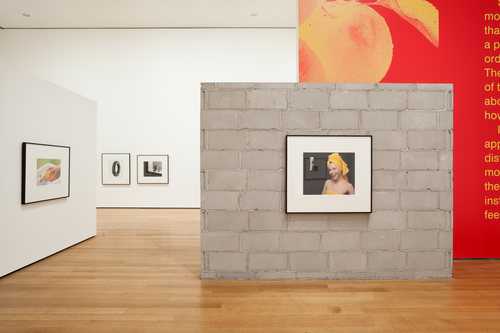
As is fitting with his perfectionist manner, American photographer Christopher Williams took an active collaborative role in the design and installation of his career-spanning survey, Christopher Williams: The Production Line of Happiness (on view July 27 to November 2, 2014), at the Museum of Modern Art. First mounted at the Art Institute of Chicago, the exhibition currently resides at MoMA and travels next to the Whitechapel Gallery in London.

Visitors may be puzzled upon arriving in the entrance area outside the exhibition’s galleries. Instead of the typical introductory wall text and related visual references, the entrance walls are covered with liner notes from a recording and installation views from past exhibits. Similar to the recent Alibis: Sigmar Polke 1963-2010 retrospective at MoMA, wall labels have been replaced with a handout. This unconventional use of wall space and lack of information in the galleries are typical of Williams’s shows.

Installation view of Christopher Williams: The Production Line of Happiness, The Museum of Modern Art, 2014. Photo by Jonathan Muzikar. © The Museum of Modern Art, New York
Installation view of Christopher Williams: The Production Line of Happiness at The Museum of Modern Art. Photo by Jonathan Muzikar. © The Museum of Modern Art, New York.

Through this installation at MoMA, Williams challenges the viewer by aiming to avoid a “neutralization” of his work within different spaces. Indeed, he has a history of using non-traditional display practices to create a consciousness of the institutional presentation of art. The artist began to develop his unique approach to display when studying at CalArts under Conceptualists Michael Asher, John Baldessari, and Douglas Huebler. Williams’s professors were renowned for creating architectural interventions and disruptions in museum and gallery shows as a way to complicate conventions of presentation.